
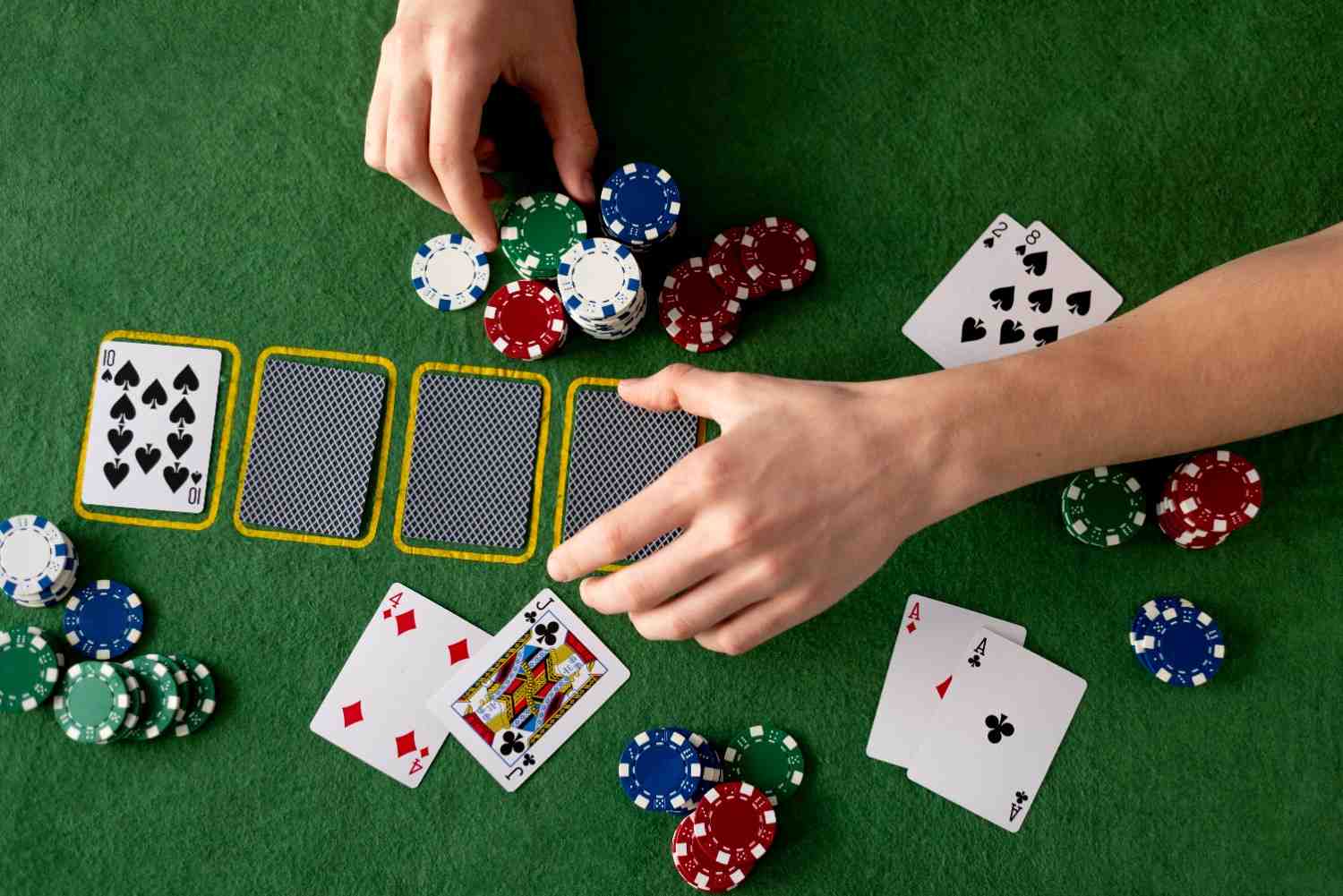
Matching Card 3 Cards Mein Aa Gaya vs 20 Cards Baad
Do Andar Bahar rounds dekho.
Round 1: Reference card Queen. Sirf 3 cards deal hue aur Queen aa gayi.
Round 2: Reference card 7. Cards nikalte gaye — 5, 10, 15… matching 7 finally 20th card ke aas-paas mila.
Ab question:
“Kya 3 cards mein match milna aur 20 cards baad match milna equally normal hai?”
Dono possible hain. Dono legitimate shuffled deck mein ho sakte hain. But mathematically, possible aur equally probable same thing nahi hoti.
Standard simplified 52-card model mein three matching-rank cards remaining hote hain. First match un three cards mein se jo sabse pehle appears karta hai, uski position hoti hai.
Isi wajah se first-match distribution beginning ki taraf weighted hoti hai.
First Matching Card Ki Position Ka Model
Suppose reference card hai:
K♣
Remaining cards:
51
Remaining Kings:
K♥, K♦, K♠
Imagine these three Kings randomly occupy three of the 51 remaining positions.
For example:
3, 18, 44
First match = position 3.
Or:
20, 31, 47
First match = position 20.
The game cares about the earliest of these positions because the first matching rank ends the sequence we’re analysing.
Therefore we’re studying the minimum position of three matching cards, not the position of one randomly selected King.
Exact Position 3 vs Exact Position 20
For the first match to occur exactly at position k, two things must be true:
1. No matching card can appear before position k.
2. Position k itself must contain one of the three matching cards.
In this simplified model:
P(first match at position k) = C(51-k, 2) / C(51, 3)
for positions where the event is possible.
Let’s compare position 3 and position 20.
For position 3:
P(K = 3) = C(48,2) / C(51,3)
= 1128 / 20825 ≈ 5.42%
For position 20:
P(K = 20) = C(31,2) / C(51,3)
= 465 / 20825 ≈ 2.23%
So under this model, the first match occurring exactly at position 3 is more than twice as likely as it occurring exactly at position 20.
That answers our central question:
Early and late exact first-match positions are not equally probable.
Why Does Probability Fall for Later Positions?
Position 3 doesn’t require the matching cards to survive very far.
For first match at position 3:
positions 1 and 2 must miss, position 3 must match.
But for first match at position 20:
positions 1 through 19 must all miss, then position 20 must match.
That’s a much more restrictive requirement.
Another way to see it:
There are three matching cards trying, in effect, to become the earliest match.
For the first match to occur very late, all three matching cards must avoid a long stretch of early positions.
This is why the distribution is front-loaded.
Position 1 has approximately:
5.88%
chance of being the first match.
Position 20 has only around:
2.23%
chance of being the exact first-match position.
And even later exact positions become progressively less likely.
Expected First Match Position Is 13 — But Don’t Misread It
There is a neat result for this simplified model.
If three matching cards are randomly positioned among 51 positions, the expected position of the earliest matching card is:
(51 + 1) / (3 + 1) = 13
So the average first-match position across a very large number of theoretical rounds is 13.
But this does not mean:
“Match normally 13th card pe hi aayega.”
And it definitely doesn’t mean:
“13 cards ho gaye, ab match due hai.”
An expected value is a long-run average, not a scheduled event.
You could observe:
position 1,
position 7,
position 24,
position 4,
position 19,
position 10…
and the long-run average across many rounds could still move toward 13.
Individual rounds don’t have to occur near the average.
“20 Cards Tak Match Nahi Aaya” — Kitna Unusual Hai?
Instead of asking whether position 20 itself is likely, ask another question:
What is the probability that no matching card appears in the first 20 positions?
For that to happen, all three matching cards must be somewhere among the remaining 31 positions.
Therefore:
P(no match in first 20) = C(31,3) / C(51,3)
= 4495 / 20825 ≈ 21.58%
So the complementary probability is:
P(at least one match within first 20) ≈ 78.42%
This gives us useful perspective.
Most theoretical rounds in this model would have produced a match by position 20.
But roughly one in five would still survive the first 20 positions without a match.
So seeing 20 non-matching cards isn’t the most common situation, but it is hardly mathematically shocking.
Less common does not mean suspicious.
What Happens Once 20 Cards Have Already Missed?
Here’s where probability gets especially interesting.
Before the round begins, surviving 20 cards without a match has probability around 21.58%.
But suppose you’ve already observed those 20 misses.
Now that’s no longer an uncertain event. It has happened.
There are:
31 unknown cards remaining
and all:
3 matching cards
are still inside them.
Therefore the probability that the next card matches is:
3/31 ≈ 9.68%
This is higher than the original:
3/51 ≈ 5.88%.
Why?
Because 20 confirmed non-matching cards have physically been removed from the finite deck.
This isn’t merely the brain saying:
“Bahut time se nahi aaya, ab due hai.”
The denominator has genuinely changed.
But 9.68% still means that the next card is much more likely to be a non-match than a match.
So increasing probability should never be confused with certainty.
Early Match Common Hai, But Very Early Match Guaranteed Nahi
Because the distribution is front-loaded, it’s tempting to conclude:
“Matching card mostly first few cards mein hi aa jana chahiye.”
Let’s quantify that.
Probability of no match in the first 5 cards:
C(46,3) / C(51,3)
Therefore:
P(match within first 5) ≈ 27.1%
So although an exact early position is individually more likely than an exact late position, most rounds do not necessarily finish within just five cards.
For the first 10 cards:
P(match within first 10) = 1 − C(41,3)/C(51,3)
≈ 49.2%
So even after 10 cards, the model is roughly around the halfway point in cumulative terms.
This illustrates why statements like:
“Early matches are more likely”
need careful interpretation.
Individual late positions have lower probability, but collectively there are many possible later positions.
One Late Match Proves Almost Nothing
Suppose somebody shares a video:
“Look! Matching card came after 28 cards. This can’t be random.”
A single unusual observation cannot establish that conclusion.
Random processes routinely produce some events that look unusual.
The right question would be:
How frequently do very late matches occur across a large complete dataset, and how does that compare with the distribution expected under the stated card model?
If 10,000 complete rounds were available, you could group first-match positions:
| First Match Position | Observed Number of Rounds |
|---|---|
| 1–5 | … |
| 6–10 | … |
| 11–20 | … |
| 21–30 | … |
| 31+ | … |
Then compare observed frequencies with the theoretical model.
That would be much more informative than focusing on one dramatic round.
Frequently Asked Questions
Is a match on card 3 more likely than a match exactly on card 20?
Yes, under the simplified 52-card model. The probability that the first match occurs exactly at position 3 is about 5.42%, compared with about 2.23% at position 20.
Why are earlier exact positions more likely?
For a late position to be the first match, all three matching cards must avoid every earlier position. That becomes increasingly restrictive as the target position moves deeper into the deck.
What is the average first matching-card position?
Under this model, the expected first-match position is 13.
Does expected position 13 mean the match is due on card 13?
No. Thirteen is a long-run mathematical average, not a prediction for an individual round.
Can the first 20 cards all be non-matches?
Yes. Under the simplified model, the probability of surviving the first 20 cards without a match is about 21.58%.
If 20 cards already missed, is the 21st card likely to match?
The conditional match probability rises to 3/31, approximately 9.68%. It has increased, but a non-match remains much more probable for that single next card.
Does a very late matching card prove manipulation?
No. Late matches have non-zero probability in an ordinary random-deck model. A meaningful assessment would require a large, complete dataset rather than one unusual round.
Do these exact percentages apply to every Andar Bahar game?
No. They apply to the simplified standard-deck model defined in this article. Different rules, deck handling or online implementations can change the relevant mathematics.
Final Takeaway
Matching card position 3 par aaya.
Another round mein position 20 par.
Dono possible hain.
But:
possible ≠ equally probable.
With three matching cards hidden among 51 positions, the first match is the earliest of those three positions.
That’s why the distribution naturally leans toward earlier positions.
Under our simplified model:
First match exactly at position 3 ≈ 5.42%
First match exactly at position 20 ≈ 2.23%
and the expected first-match position is:
13.
But none of this means a late match is abnormal or an early match is guaranteed.
And if 20 cards have already passed without a match, the correct mathematical response isn’t:
“Ab toh next pakka!”
It’s:
“There are now 3 matching cards among 31 unknown cards, so the next-card probability is 3/31.”
That’s the difference between intuition and conditional probability.
Editorial Note: This article uses a simplified model with a standard 52-card deck, one reference card removed, three matching-rank cards among the remaining 51, and dealing without replacement until the first match. Exact Andar Bahar rules and online implementations can differ. The calculations are for mathematical education and are not wagering advice.