
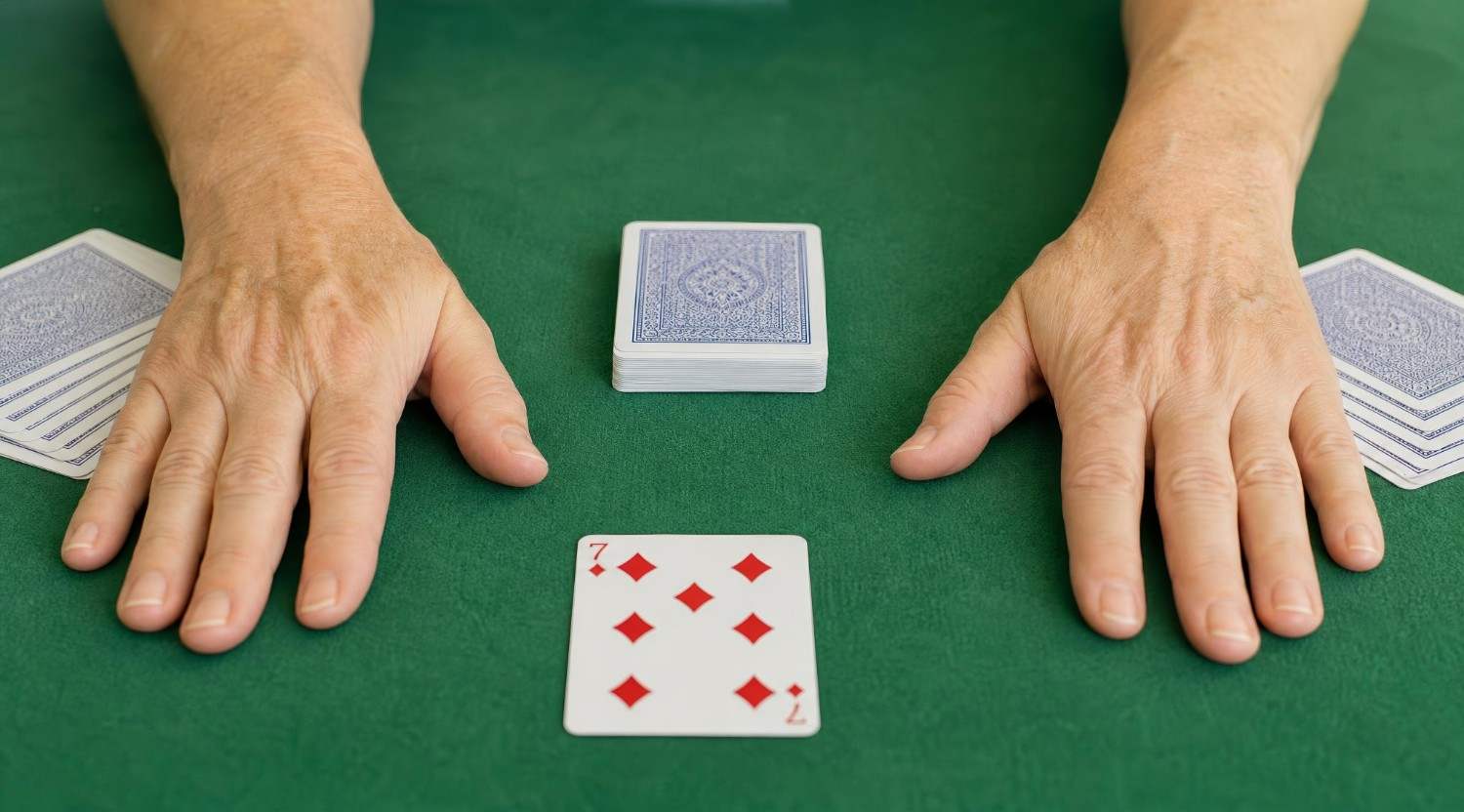
Andar Ya Bahar:Kya Dono Side ka Chance Really 50-50 Hota Hai?
Naam hi hai Andar Bahar. Do sides hain. Toh simple logic kya bolega?
Andar = 50%
Bahar = 50%
Bilkul coin toss jaisa — Head ya Tail.
But yahin ek interesting mathematical problem hai. Traditional Andar Bahar mein sirf do labels nahi hote; cards ek fixed order mein deal hote hain, aur matching-rank card kis position par appear karta hai, usse winning side decide ho sakti hai.
Isliye “do outcomes hain, toh probability automatically 50-50 hogi” mathematically necessary nahi hai.
Actually question ye hai:
Matching card kin possible positions par aa sakta hai, aur un positions mein se kaun Andar ko belong karti hain aur kaun Bahar ko?
Isi se 50-50 wali intuition ko properly examine kiya ja sakta hai.
Do Outcomes Hone Ka Matlab Equal Probability Nahi Hota
Sabse pehle ek common misunderstanding clear karte hain.
Suppose ek box mein 10 balls hain:
- 9 red
- 1 green
Aapke paas technically sirf two possible colour outcomes hain:
Red or Green.
But probability obviously:
P(Red) = 90%
P(Green) = 10%.
Two outcomes ≠ equal outcomes.
Exactly isi reason se Andar aur Bahar naam ki two sides dekh kar directly 50-50 conclude karna enough nahi hai.
We need the rules.
Traditional Card Logic Mein Matching Rank Important Hai
A common Andar Bahar structure ko simplified form mein samjho.
52-card deck se ek reference card reveal hota hai. Suppose reference card hai:
7♥
Ab reference card ka suit main issue nahi; matching rank relevant hota hai.
Deck mein originally four 7s the:
7♥, 7♦, 7♣, 7♠.
Reference card ek 7 already use ho chuka, so remaining unseen cards mein theoretically three matching 7s remain.
Cards alternating sides par deal kiye jaate hain until another 7 appears.
Example:
Andar: K♣
Bahar: 3♥
Andar: 9♦
Bahar: A♠
Andar: 7♣
Matching rank Andar position par appeared, so under this simplified example Andar would be the matching side.
The crucial point:
Cards are being assigned sequentially, not by flipping a fresh 50-50 coin for every side.
First Card Kis Side Ko Milta Hai? Yahin Se Asymmetry Aa Sakti Hai
Imagine 51 unseen cards remain after the reference card.
Suppose the first dealt card goes to Andar and dealing alternates:
Position 1 → Andar
Position 2 → Bahar
Position 3 → Andar
Position 4 → Bahar
Position 5 → Andar
and so on.
Notice something?
There are 51 positions — an odd number.
So one side receives positions:
1, 3, 5, … 51
while the other receives:
2, 4, 6, … 50.
That gives:
26 odd positions
versus:
25 even positions.
But don’t jump to:
“26 vs 25 means Andar probability is simply 26/51.”
Why? Because there are three matching cards among the remaining cards, and the game stops at the first one encountered.
Therefore the mathematics involves the location of the earliest matching card, not simply choosing one random card from 51.
First Matching Card Creates the Interesting Mathematics
Suppose the three remaining matching cards randomly occupy positions among the 51 unseen cards.
For example:
Positions 8, 31 and 46.
The first match is at position 8.
If even positions correspond to Bahar, then Bahar gets the match.
Another arrangement:
Positions 13, 22 and 49.
First match = position 13.
If odd positions correspond to Andar, Andar gets it.
Notice that positions 22 and 49 no longer matter for deciding the first match because position 13 already ended the sequence.
Mathematically, we are interested in:
minimum(X1, X2, X3)
where the X values represent positions of the three remaining matching-rank cards.
Then we ask:
Is that minimum position odd or even?
That’s quite different from a basic coin toss.
So Is One Side Actually More Likely?
Under a particular traditional dealing rule, the side receiving the first card can have a small structural difference from the other side because the first matching card’s position determines the outcome.
But the exact probability depends on the precise rules being analysed — including which side receives the first card and how the game handles the reference card and dealing sequence.
This matters especially online because two games carrying the label “Andar Bahar” should not automatically be assumed to implement every rule identically.
Therefore instead of saying:
“Andar is always X% and Bahar is always Y%,”
the technically safer approach is:
define the exact rule set first, then calculate probabilities for that rule set.
There is another important distinction too:
winning probability and payout economics are not the same thing.
A side being slightly more likely does not automatically mean it has a favourable expected return. Payouts, commissions and other rules matter separately.
Why a Tiny Probability Difference Is Hard to Spot From History
Suppose purely hypothetically that two outcomes had underlying probabilities:
Side A = 51.5%
Side B = 48.5%.
These are illustrative numbers, not claimed Andar Bahar probabilities.
After 20 rounds, you might see:
A = 8
B = 12.
Does that prove B is more likely?
No.
After another 20:
A = 13
B = 7.
Short samples fluctuate.
Even if an underlying probability is slightly above 50%, it doesn’t mean that side must dominate every block of 10, 20 or 50 observations.
This is why a screenshot of recent results is poor evidence for estimating a small mathematical edge.
Large consecutive samples are much more informative.
50-50 Myth Aur “Due” Myth Ko Mix Mat Karo
Suppose someone believes:
“Andar aur Bahar exactly equal hain.”
History then shows:
A → A → A → A → A.
They conclude:
“Balance ke liye Bahar ab aana hi chahiye.”
That’s a second assumption layered on top of the first.
Even a truly 50-50 independent process doesn’t need to balance immediately.
A fair coin can produce:
H H H H H H
without becoming unfair.
And if an Andar Bahar rule set isn’t exactly 50-50 to begin with, forcing short-term balance becomes even less justified.
Long-run probability describes frequencies across many repetitions. It doesn’t create a scheduler saying:
“Andar zyada ho gaya, ab next Bahar bhejo.”
How Could You Check an Andar Bahar Probability Claim?
There are two different approaches.
First: mathematical analysis.
Take the exact card rules and calculate all relevant possible positions of the first matching card.
This is the stronger approach when the dealing mechanics are known.
Second: empirical observation.
Collect a large consecutive dataset and calculate:
Observed Andar frequency = Andar results / total rounds
Observed Bahar frequency = Bahar results / total rounds.
For example, a fictional 1,000-round dataset might show:
| Side | Results | Observed Frequency |
|---|---|---|
| Andar | 518 | 51.8% |
| Bahar | 482 | 48.2% |
Would that prove the true probabilities are exactly 51.8% and 48.2%?
No.
Those are sample frequencies. Another 1,000 rounds could produce somewhat different percentages.
Theoretical probability and observed sample frequency should not be confused.
Frequently Asked Questions
Is Andar Bahar exactly 50-50?
Not necessarily. Two possible sides do not automatically imply equal probability. Exact probabilities depend on the specific dealing rules and how the first matching-rank card determines the result.
Why can the first-card side matter?
Because alternating dealing creates odd and even card positions. If the first matching card determines the result, which side receives which positions can create a mathematical asymmetry.
Are Andar Bahar and coin toss mathematically the same?
No. A coin toss can model two equal independent outcomes, while Andar Bahar involves cards, matching ranks and ordered dealing. Coin tosses are useful for explaining some probability concepts but aren’t a complete model of the card game.
Does the side with more possible card positions automatically win more often?
Not that simply. Multiple matching cards remain after the reference card, and the earliest matching card matters. Therefore the distribution of the first matching position has to be analysed.
If Andar has appeared more often recently, should Bahar catch up?
Not automatically. Short-term imbalance can occur naturally, and long-run probabilities do not require immediate compensation in the next few rounds.
Can I estimate Andar/Bahar probability from 20 results?
Twenty rounds are a very small sample for estimating a small probability difference. Random variation can easily dominate such a short history.
Is winning probability the same as expected return?
No. Expected return also depends on payout and other game rules. A more frequently occurring outcome is not automatically economically favourable.
Are the percentages in this article official JetX or Andar Bahar platform probabilities?
No. Hypothetical percentages and datasets are used only to explain the mathematics. Exact platform-specific probabilities require the exact verified rule set.
Final Takeaway
“Andar aur Bahar do options hain, toh obviously 50-50 hoga.”
Sounds reasonable.
But probability doesn’t count the number of labels. It counts the underlying ways those outcomes can occur.
In a card-based Andar Bahar model, the important questions include:
Which side receives the first card?
Where can the remaining matching-rank cards appear?
Which matching card appears first?
How does the exact rule set convert that position into Andar or Bahar?
Once these are defined, the probability can be calculated rather than guessed.
So “two sides = 50-50” is not a mathematical rule.
And even if a particular system were close to 50-50, that still wouldn’t mean every short history should contain equal numbers of Andar and Bahar.
That’s the bigger lesson:
50-50-looking and mathematically 50-50 are not necessarily the same thing.
Editorial Note: This article discusses probability using simplified and hypothetical Andar Bahar models. Exact probabilities depend on the precise rules and implementation of the game being analysed. Illustrative percentages and datasets are not presented as verified probabilities for any specific online platform. The content is educational and does not provide betting or wagering advice.