
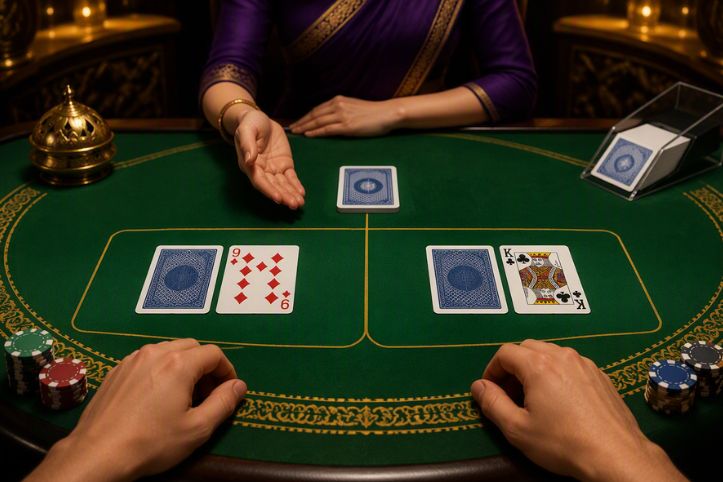
How to Play Andar Bahar: Rules, Gameplay and Tips for Beginners
If you’re new to Indian card games, Andar Bahar is one of the easiest games to understand. The game revolves around a single opening card and two sides: Andar and Bahar.
The goal is to predict which side will receive a card matching the rank of the opening card first.
There are no complicated card combinations to learn. Once you understand the basic sequence, you can follow an entire round with ease.
Table of Contents
- What Is Andar Bahar?
- What You Need to Play
- Step-by-Step Andar Bahar Rules
- What Is the Joker or Game Card?
- Andar vs Bahar
- Example of a Round
- Understanding Payouts
- Common Andar Bahar Variations
- Common Mistakes Beginners Make
- Can You Predict the Winning Side?
- Responsible Gaming
- Conclusion
1. What Is Andar Bahar?
Andar Bahar is a traditional Indian card game played with a standard deck.
The dealer first reveals a card in the centre of the table. Players then choose whether the matching rank will appear on Andar or Bahar.
Cards are subsequently dealt according to the particular version’s dealing rules until a card with the same rank as the opening card appears.
The side receiving that matching card is the winning side.
2. What You Need to Play
The traditional game requires:
- One standard 52-card deck
- A dealer
- An Andar side
- A Bahar side
- A central opening card
Online versions recreate these elements through a digital interface or live-dealer table.
The exact betting limits, payout rules and additional features depend on the platform.
3. Step-by-Step Andar Bahar Rules
Step 1: Shuffle the Deck
The dealer prepares and shuffles the standard deck.
Step 2: Reveal the Opening Card
One card is placed face-up in the centre.
This card establishes the rank that the dealer will be looking for during the rest of the round.
Step 3: Choose Andar or Bahar
The main prediction is whether the matching card will appear on Andar or Bahar.
Step 4: Begin Dealing
The dealer deals cards to the two sides according to the specific table’s rules.
Step 5: Look for the Match
The dealer continues dealing until a card with the same rank as the opening card appears.
Step 6: Determine the Result
The side where the matching card appears becomes the winning side for that round.
This core sequence is common to standard versions of Andar Bahar, although dealing order and additional betting features can vary.
4. What Is the Joker or Game Card?
One of the terms that can confuse new players is “Joker.”
In Andar Bahar, the term often refers to the first card revealed in the centre of the table. It is not necessarily an actual Joker card from the deck.
For example, if the dealer reveals the Queen of Clubs, the target rank for that round is Queen.
The game ends when another Queen appears on either Andar or Bahar.
5. Andar vs Bahar
The main difference between the two choices is simply where the matching card appears.
Andar: The matching card appears on the Andar side.
Bahar: The matching card appears on the Bahar side.
The terms come from Hindi, with Andar meaning “inside” and Bahar meaning “outside.”
Different versions can use different dealing sequences and payout structures, so don’t assume that every online table operates identically.
6. Example of a Round
Let’s say the opening card is:
5 of Clubs
The target rank is therefore 5.
The dealer begins dealing cards:
| Side | Card |
| Andar | 8 |
| Bahar | Queen |
| Andar | 3 |
| Bahar | 10 |
| Andar | 5 |
The matching 5 appears on Andar.
Therefore, Andar is the winning side of the round.
The suits of the cards don’t matter for the basic matching objective; the relevant feature is the card’s rank.
7. Understanding Payouts
Payout structures are not identical across every Andar Bahar version.
Some formats use different payouts depending on when the matching card appears, while others offer additional side bets.
For example, certain live-dealer variants can apply different payouts to early-card outcomes.
This is why checking the specific game’s rules and payout table before placing a bet is important.
Don’t assume that the payout from one Andar Bahar table will apply to another.
8. Common Andar Bahar Variations
Modern platforms can offer variations of the traditional format.
These may differ in:
- Dealing order
- Payout structure
- Side bets
- Additional betting rounds
- Presentation style
- Betting limits
Some live versions introduce additional betting opportunities after the first cards have been dealt.
The underlying concept, however, remains centred on matching the rank of the opening card.
9. Common Mistakes Beginners Make
Assuming Every Table Uses the Same Rules
Different versions can have different dealing and payout structures.
Confusing the Game Card With a Real Joker
The “joker” generally refers to the opening reference card, not a wild Joker card.
Chasing Previous Results
A series of Andar or Bahar results doesn’t guarantee that the opposite side will win next.
Ignoring the Payout Table
Understanding where the matching card can appear is only part of the game. Check how the particular table settles winning bets.
Believing in Guaranteed Systems
Because the outcome involves chance, no system can guarantee a winning result.
10. Can You Predict the Winning Side?
There is no reliable method for predicting the exact side that will receive the matching card in every round.
The cards are shuffled and dealt according to the game’s rules, and players don’t control the sequence.
Consequently, previous results should not be treated as a dependable prediction of future rounds.
Andar Bahar’s simplicity should not be confused with predictability.
11. Responsible Gaming
If you play Andar Bahar for money, set limits before starting.
A responsible approach means:
- Decide your budget in advance.
- Don’t chase losses.
- Never borrow money to gamble.
- Avoid increasing stakes impulsively.
- Take breaks.
- Check whether the activity is legally permitted in your location.
As with other gambling activities, the possibility of losing money should always be considered.
12. Conclusion
Learning how to play Andar Bahar is relatively straightforward. Start with the opening card, choose between Andar and Bahar, follow the dealing sequence and watch for the first card matching the opening card’s rank.
Its simplicity is the reason the game has remained appealing across generations and formats.
Whether you’re exploring its traditional roots or learning how a modern live-dealer version works, understanding the specific table’s rules and payouts is the best place to start.